The Science of Magic: How Do Hologram Projectors Actually Work?
Have you ever wondered what happens when you see those stunning three-dimensional images floating in mid-air at concerts, museums, or tech conferences? What seems like pure magic is actually rooted in fascinating physics and cutting-edge technology. Hologram projectors have transitioned from science fiction fantasy into our everyday reality, and today we’re going to demystify exactly how these incredible devices create those mesmerizing floating images that appear to defy the laws of nature.
The journey from imagination to innovation is a remarkable one, and understanding hologram projectors gives us insight into how technology continues to blur the line between what we thought was impossible and what we can now hold in our hands. Let’s dive deep into this captivating world.
Understanding the Basics: What Exactly Is a Hologram?
Before we can truly understand how hologram projectors work, we need to grasp what a hologram actually is. Think of it this way: a traditional photograph captures only one perspective of an object, like a flat snapshot frozen in time. A hologram, however, is something entirely different. It’s a three-dimensional representation that contains information about an object from multiple angles simultaneously.
A hologram works by recording and reproducing the light that bounces off an object. When light waves from different perspectives are captured and then replayed, your eyes and brain perceive depth, dimension, and the illusion of a real object floating in space. It’s not a projection on a screen—it’s actually light being manipulated to create what we perceive as a three-dimensional image.
The Historical Context: From Theory to Reality
How Holograms Were First Discovered
The concept of holograms didn’t emerge overnight. Back in 1947, a Hungarian physicist named Dennis Gabor developed the theoretical foundation for holography while trying to improve electron microscope images. However, his idea remained largely theoretical until the invention of the laser in 1960. Without coherent light sources like lasers, creating true holograms was virtually impossible.
The Evolution to Modern Hologram Projectors
Fast forward to today, and we’ve gone from laboratory experiments to consumer-accessible technology. Modern hologram projectors represent generations of refinement, combining advances in laser technology, computing, optical engineering, and digital display systems. What started as an academic curiosity has become a tool for entertainment, education, medical training, and business presentations.
The Core Technology: How Light Creates the Illusion
Understanding Coherent Light and Lasers
The foundation of any hologram projector is coherent light, and lasers are the primary source of this. But what makes laser light so special? Unlike regular light from a bulb, which scatters in random directions, laser light travels in a focused, organized beam with all waves synchronized and moving in the same direction. This coherence is absolutely essential for creating holograms.
When laser light hits an object, it reflects and creates what’s called an object wave. Simultaneously, some of the laser light travels directly without hitting the object, creating a reference wave. The interaction between these two waves creates an interference pattern—a unique map of light and dark areas that encodes all the three-dimensional information about the object.
The Role of Interference Patterns
Imagine dropping two pebbles into a still pond. Where the ripples from each pebble meet, they create patterns of reinforcement and cancellation. This is interference, and it’s exactly what happens with light waves in a hologram. These interference patterns are incredibly detailed and contain massive amounts of information. When the hologram is illuminated later, these patterns diffract the light in such a way that your eyes perceive a three-dimensional image.
Types of Hologram Projectors: Different Approaches to the Same Goal
Transmission Holograms
Transmission holograms require light to pass through them from behind to create the visible image. You’ve likely seen these in museums or science centers where a laser shines through a plate and produces a floating image. The advantage here is exceptional image quality and incredible detail. The downside? They require specific viewing angles and proper lighting conditions.
Reflection Holograms
Reflection holograms work differently—they don’t require light passing through them. Instead, they reflect light off their surface to produce the image. This means they can be viewed under regular white light and from various angles. Many of the holograms you see on credit cards or security documents are reflection holograms, which is why they shimmer and change as you tilt them.
Digital Hologram Projectors
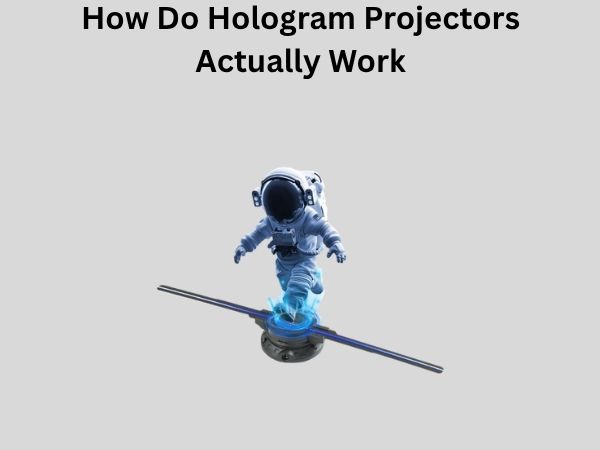
This is where modern technology gets really exciting. Digital hologram projectors don’t work with physical holograms at all. Instead, they use sophisticated algorithms and optical devices to create the illusion of a three-dimensional image in real-time. These can display animated content, allowing for dynamic, changeable holograms rather than static images.
The Technical Process: Step by Step
Recording the Holographic Data
The first step in creating a hologram involves recording. A laser is split into two beams: the object beam and the reference beam. The object beam illuminates the subject while the reference beam shines directly onto a photographic plate or digital sensor. Where these beams meet, they create interference patterns that are recorded on the medium. This entire process happens at the speed of light and requires incredibly precise equipment to maintain coherence.
Reconstruction and Playback
Once the holographic data is recorded, reconstruction is the next phase. When the recorded hologram is illuminated with laser light (or in some modern systems, LED light), it diffracts the light in exactly the same pattern as the original subject. Your eyes receive light rays that appear to come from a three-dimensional object, even though there’s nothing physically there. This is where the magic happens—your brain interprets these light patterns as a solid, three-dimensional object floating in space.
The Role of Diffraction
Diffraction is the key principle that makes holograms work. When light encounters the fine patterns in a hologram, it bends and spreads out in specific ways. These bending patterns recreate the exact light waves that originally bounced off the object. It’s like the hologram is a blueprint that tells light how to behave, and that behavior produces the three-dimensional image we perceive.
Modern Hologram Projector Technologies
Spatial Light Modulators (SLMs)
Contemporary hologram projectors often use something called a Spatial Light Modulator. Think of it as a sophisticated digital screen that can control the amplitude and phase of light waves passing through it. An SLM contains millions of tiny pixels that can individually control how light behaves, allowing the device to calculate and display holographic content digitally.
Computer-Generated Holograms
Instead of physically recording an object, modern projectors can use computers to calculate what the interference pattern should be for any desired three-dimensional image. This is revolutionary because it means you can create holograms of things that don’t exist in physical reality—fantasy creatures, abstract designs, or complex scientific models. The computer performs millions of calculations to generate the exact pattern needed, then displays it on an SLM or writes it to a physical medium.
Laser and LED Light Sources
While lasers are ideal for creating holograms due to their coherence, modern projectors increasingly use specialized LED lights and optical systems that approximate laser-like properties. This makes hologram projectors more affordable and accessible to consumers and businesses. The trade-off is sometimes slightly reduced image quality, but the convenience factor is substantial.
The Physics Behind the Visual Experience
How Your Eyes Perceive Depth
Our eyes determine depth through several mechanisms. One crucial method is parallax—the slight difference in what each eye sees. When you look at a hologram, your two eyes receive slightly different perspectives of the three-dimensional image, just as they would with a real object. Your brain automatically processes this difference and creates the sensation of depth. Additionally, holograms can produce proper focus cues; your eyes focus at the actual distance where the holographic image appears to be, not at the surface of the display.
The Wavefront Reconstruction Principle
Here’s something truly elegant about holography: when light passes through or reflects off a hologram, it reconstructs the exact wavefront that the original object produced. A wavefront is the surface connecting all points of light that are in the same phase—imagine the crest of a water wave extending outward. By reconstructing this wavefront, the hologram creates light that behaves identically to light reflecting off the original object, producing a perfect three-dimensional illusion.
Applications of Hologram Projector Technology
Entertainment and Live Events
One of the most visible uses of hologram projectors is in entertainment. Major concerts have featured holographic performances of deceased artists, creating haunting and memorable experiences. Museums use holograms to display artifacts in ways that traditional exhibits cannot achieve, allowing visitors to see ancient objects from all angles without risking damage to originals.
Medical and Scientific Fields
In medical training, hologram projectors display three-dimensional anatomical models that help students and surgeons prepare for complex procedures. Scientists use holograms to visualize molecular structures, allowing them to understand complex chemistry in ways that two-dimensional diagrams never could. These applications demonstrate how holography transcends entertainment into serious professional domains.
Business and Communication
Imagine attending a business meeting where a colleague appears as a three-dimensional hologram in the conference room. Technology companies are developing holographic communication systems that could revolutionize remote work and international collaboration. These systems promise to make virtual presence feel far more real and engaging than current video conferencing.
Retail and Advertising
Retailers are beginning to experiment with holographic displays to showcase products in eye-catching ways. A jewelry store might display a floating three-dimensional representation of a piece, allowing customers to see it from every angle without handling it. Advertisers use holographic billboards to capture attention in ways that static displays cannot match.
The Challenges and Limitations
Cost and Accessibility
One of the biggest barriers to widespread hologram projector adoption is cost. High-quality systems remain expensive, with professional-grade equipment often requiring five or six-figure investments. While prices are decreasing as technology matures, true three-dimensional holographic displays accessible to consumers remain limited. The gap between laboratory demonstrations and consumer products remains significant.
Image Quality and Viewing Angles
Not all hologram projectors offer perfect image quality or allow viewing from every possible angle. Some systems only work within specific viewing windows, limiting their practical applications. Color representation can also be challenging, with many holograms appearing as monochromatic green or red images rather than full-color displays. Engineers continue working on these limitations.
Power Consumption
Hologram projectors, especially those using lasers or requiring extensive computational power, consume significant amounts of electricity. This limits their portability and raises operational costs. As technology evolves toward more efficient light sources and computational methods, this challenge should diminish.
The Future of Hologram Projector Technology
Emerging Innovations
Researchers are constantly pushing the boundaries of holography. Some projects are developing holographic displays that work without requiring special viewing glasses or specific angles, working more like traditional screens but with full three-dimensional capability. Others are exploring augmented reality integration, where holograms could interact with the physical environment and viewer perspective in real-time.
Miniaturization and Portability
The trajectory of technology suggests that hologram projectors will become smaller and more portable. Imagine a handheld device that could project three-dimensional holograms—this isn’t science fiction anymore but an active area of development. As components shrink and costs decrease, personal hologram projectors could become as common as smartphones.
Integration with Artificial Intelligence
Future hologram projectors might integrate artificial intelligence to create interactive, responsive holograms. An AI-powered holographic assistant could adapt its appearance and behavior based on user interaction, creating more immersive and personalized experiences. The combination of holography and AI opens possibilities we’re only beginning to imagine.
Conclusion
Hologram projectors represent a fascinating intersection of physics, engineering, and creativity. What once seemed like pure fantasy has become tangible reality through the understanding and manipulation of light itself. From the interference patterns created by coherent laser beams to the sophisticated algorithms that calculate digital holograms, these devices embody humanity’s drive to push technological boundaries.
The journey from Dennis Gabor’s theoretical framework in 1947 to today’s sophisticated digital projectors demonstrates how fundamental research eventually transforms into practical applications that enrich our world. Whether they’re used for entertainment, education, medicine, or business communication, hologram projectors continue to evolve and expand their capabilities.
As costs decrease and technology improves, we can expect holographic displays to become increasingly common in our daily lives. The magic of holograms isn’t actually magic at all—it’s elegant physics, clever engineering, and the remarkable properties of light. And perhaps that makes it even more wonderful: the technology is rooted in understanding and innovation rather than illusion. The next time you encounter a hologram, you’ll know you’re witnessing not fantasy, but the triumph of human ingenuity and our expanding ability to shape light itself.
Frequently Asked Questions About Hologram Projectors
Can hologram projectors display full-color images like a regular screen?
While modern hologram projectors are increasingly capable of displaying color images, full-color holography remains more challenging than monochromatic displays. Different wavelengths of light behave differently in holographic systems, so creating vibrant, true-color holograms requires careful engineering. Many consumer and professional systems can now display multiple colors, though purists might argue that the colors don’t yet match the vibrancy of traditional displays. As technology advances, color representation continues to improve, and full-color holographic displays are becoming increasingly feasible.
Do you need special glasses to see a hologram from a hologram projector?
It depends on the type of hologram projector. True three-dimensional holograms that reconstruct light wavefronts can be viewed without special glasses because your eyes naturally perceive the depth through binocular vision and focus cues. However, some digital holographic systems designed for larger displays might use special glasses similar to 3D movie technology. The ideal hologram projectors are those that create images viewable from multiple angles without any equipment, and many modern systems are moving toward this goal.
How much space do hologram projectors need, and can they fit in a home?
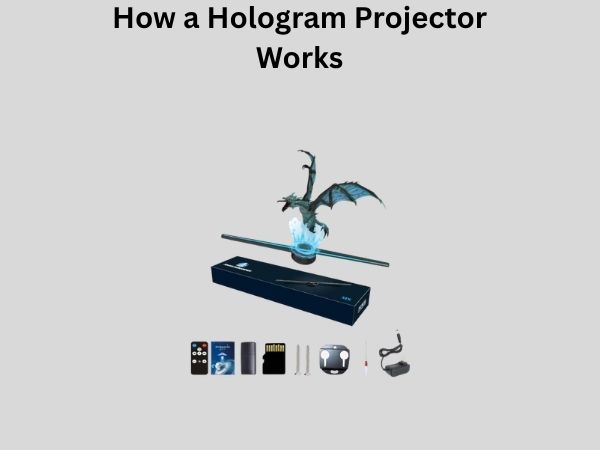
The space requirements for hologram projectors vary significantly depending on the type and quality. Professional concert-grade systems might require considerable space and specialized infrastructure. However, smaller, consumer-oriented hologram projectors are increasingly available and can fit on tabletops or shelves. These personal devices typically project images within a specific viewing area, usually a few feet in diameter. As technology becomes more compact, hologram projectors suitable for home use are becoming more practical and affordable.
What’s the difference between a hologram and augmented reality?
While both create the perception of three-dimensional objects in space, they work quite differently. True holograms reconstruct light wavefronts from physical media or calculated digital data, creating images that actually exist in space independent of any particular viewer. Augmented reality, by contrast, uses cameras and processors to overlay digital images onto a display, and these images are fundamentally tied to the device screen. You could say holograms are objective (existing in the space itself), while AR is subjective (existing only on your personal device). That said, future technologies might blur these distinctions.
How much do hologram projectors cost, and are they worth the investment?
Consumer hologram projectors can range from a