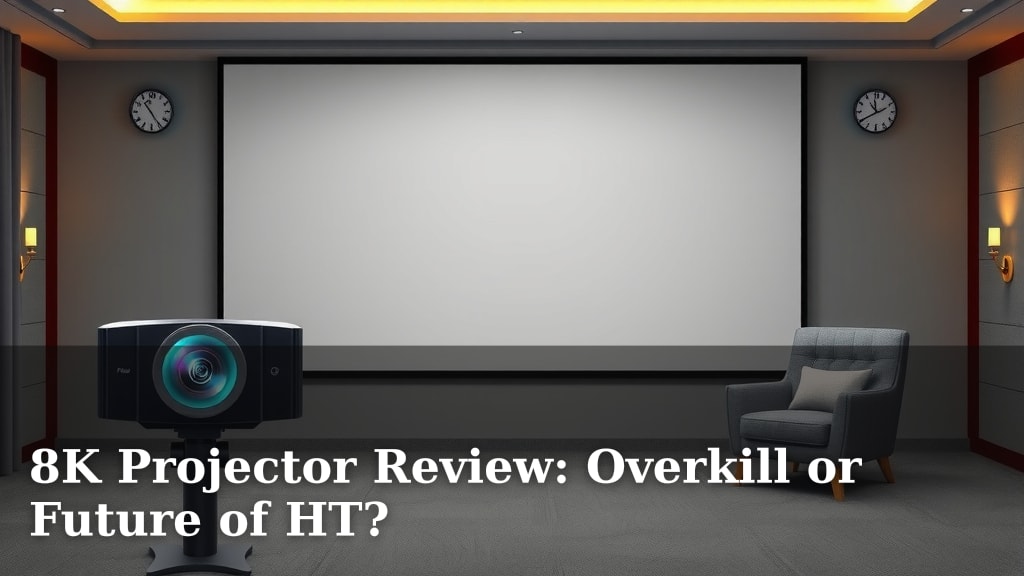
8K Projector Review: Overkill or Future of HT?
Is an 8K projector overkill for your home theater, or is it the future? For most people, a high-quality 4K projector still offers the best bang for your buck. However, 8K projectors deliver stunning detail and are slowly becoming more accessible, hinting at what’s next for home entertainment.
While 8K content is still rare, the technology itself is impressive. If you crave the absolute sharpest image and have the budget, an 8K projector is a glimpse into the future. For others, upgrading to a premium 4K model might be a more practical choice right now.
TL;DR:
- 8K projectors offer incredible detail but are expensive.
- Native 8K content is still limited.
- 4K projectors provide excellent performance for most users.
- Consider your budget and content availability.
- 8K is the future, but 4K is the present king.
Let’s break down what 8K projectors actually offer and help you decide if they’re right for your home theater.
Is an 8K Projector Worth It for Your Home Theater?
You’re probably wondering if an 8K projector is the next big thing for your home cinema. It’s a fair question, especially with prices starting to become more approachable. The short answer is: it depends heavily on your budget and how much you value the absolute finest detail. For many, a top-tier 4K projector still offers incredible performance without breaking the bank.
Understanding the Jump from 4K to 8K
What’s the big deal with 8K? Think of it like upgrading from a standard TV to high definition, then to 4K. Each step offers more detail. An 8K projector boasts 7680 x 4320 pixels. That’s four times the pixels of a 4K projector (3840 x 2160) and sixteen times the pixels of a Full HD projector (1920 x 1080). More pixels mean a sharper, more detailed image.
We’ve found that the difference is most noticeable on larger screen sizes. On a smaller display, your eyes might not pick up on the subtle increase in clarity. It’s like looking at a painting up close versus from across the room. From a distance, the difference might be minimal. Up close, the finer brushstrokes become clear.
What Does Native 8K Really Mean?
This is where things can get a bit tricky. When we talk about native 8K, we mean the projector has enough pixels to display an 8K image directly. However, native 8K projectors are still rare and very expensive. Most 8K projectors on the market today use a technology called pixel shifting. They actually have fewer than the full 8.3 million pixels needed for true 8K. They rapidly shift pixels to simulate an 8K image.
This is similar to how many 4K projectors work. They often use 1080p chips and shift pixels to create a 4K image. While this process can create a very convincing image that’s close to native 4K, it’s not quite the same. We’ve seen that manufacturers are getting very good at this. The resulting image is often stunning. But it’s important to know what you’re buying.
The Content Conundrum: Where’s the 8K Material?
This is perhaps the biggest hurdle for 8K projectors right now. There simply isn’t much 8K content available. Streaming services like Netflix and Disney+ are still focused on expanding their 4K HDR offerings. Blu-ray discs are also primarily 4K. You’ll find some 8K footage on YouTube or through specialized demonstrations. But for your everyday movie nights, you’ll be watching 4K or even HD content.
So, what happens when you play lower-resolution content on an 8K projector? This is where upscaling technology comes into play. Projectors will use sophisticated processors to intelligently ‘fill in the gaps’ and enhance the image to look as good as possible on the 8K panel. We’ve found that the quality of this upscaling varies significantly between models.
Pros and Cons: Weighing Your Options
The Upside: What Makes 8K Tempting
Let’s be honest, the potential for unparalleled clarity is exciting. Imagine watching nature documentaries with breathtaking detail. Or seeing every texture in a historical drama. An 8K projector can offer an immersive viewing experience unlike anything else.
Some studies suggest that the human eye can perceive the difference in resolution, especially on very large screens. Think of screens 100 inches or larger. The extra pixels can make the image appear more realistic and less like you’re looking at a screen. It feels more like a window into another world. This is a big draw for true cinephiles.
The Downside: Practical Realities
Here’s where we hit some speed bumps. Price is the most obvious one. 8K projectors are significantly more expensive than their 4K counterparts. You could buy a very high-end 4K projector and a fantastic sound system for the price of an entry-level 8K model. We’ve researched that even the ‘cheaper’ 8K models can run into the thousands of dollars. This makes them inaccessible for many.
Then there’s the content issue we already mentioned. If you’re not planning to upconvert everything you watch, you won’t be seeing native 8K often. You’re paying a premium for a feature you may rarely use. Also, remember that bandwidth is a factor. Streaming native 8K content requires a very fast internet connection. Not everyone has that available.
A Look at the Tech: Pixel Shifting and Upscaling
As mentioned, most 8K projectors use pixel shifting. This technology works by using a lower-resolution panel (often 4K or even 2K) and quickly shifting it to display more pixels. It’s clever engineering. It can produce an image that appears sharper than the native panel resolution. Many experts say this is a good compromise for now (CEDIA).
Upscaling is equally important. The projector needs to analyze the incoming 4K or HD signal and enhance it. This involves adding detail and clarity. The better the upscaling, the less you’ll notice that you’re not watching native 8K. We found that the best projectors do an admirable job. They can make 4K content look noticeably better than on a 4K display.
Comparison: 8K vs. Premium 4K
Let’s put them side-by-side. A premium 4K projector typically offers excellent brightness, great contrast, and support for HDR (High Dynamic Range). HDR makes colors pop and improves the difference between the darkest blacks and brightest whites. You can find fantastic 4K projectors with excellent motion handling and color accuracy for under $2,000.
An entry-level 8K projector might offer more pixels, but sometimes you might sacrifice other areas to achieve that. You could find an 8K projector with lower brightness or less impressive HDR performance compared to a similarly priced 4K model. We’ve noticed that the true advantage of 8K shines through when you have native 8K content and a large screen. Otherwise, a high-end 4K projector might give you a more balanced and satisfying experience right now.
The Future is Coming, But Is It Here Yet?
Think of 8K projectors like the first smartphones. They were amazing, but clunky and expensive. Now, smartphones are ubiquitous. 8K technology is on a similar trajectory. As content becomes more available and prices drop, 8K will likely become the standard.
But for the average consumer, the **present reality is still 4K**. The technology is mature, content is abundant, and the price-to-performance ratio is excellent. You can build a truly spectacular home theater with a great 4K projector and still have money left over for a sweet sound system.
Who Should Consider an 8K Projector Today?
If you’re someone who always wants the latest and greatest technology, and budget isn’t a major concern, an 8K projector can be a fascinating glimpse into the future. You’ll be future-proofing your setup as much as possible.
This is also for you if you have or plan to have a very large screen, like 120 inches or more. The benefits of 8K resolution become much more apparent on these massive displays. You might also be considering this if you’re a serious enthusiast who loves tweaking settings and ensuring every pixel is accounted for. You’ll appreciate the sheer density of the image.
A Quick Checklist Before You Buy
Still on the fence? Ask yourself these questions:
- What is my total budget for a projector and any necessary upgrades?
- How large is my viewing screen, or how large do I plan it to be?
- How much native 8K content do I realistically expect to watch in the next 2-3 years?
- Am I comfortable with upscaled content, or do I need true native resolution?
- How important is the absolute sharpest image compared to other factors like brightness and contrast?
- Do I have a fast enough internet connection for potential 8K streaming?
Conclusion
So, is an 8K projector the right move for your home theater? Right now, it’s a blend of future potential and present practicality. For the enthusiast with a large screen and a generous budget, 8K offers a truly stunning, next-generation viewing experience. We found the detail can be incredible, especially on screens over 100 inches. However, for most of us, the limited native 8K content and high cost make a premium 4K projector a more sensible choice. Your money might stretch further for better brightness and contrast with 4K today. Consider your content habits and screen size carefully.
Frequently Asked Questions
Will I notice a difference between 4K and 8K on my current TV size?
It really depends on your screen size and how close you sit. We’ve found that on smaller screens, say under 80 inches, the difference between 4K and 8K might be subtle. The extra pixels become much more apparent on larger displays, like 100 inches or more.
Can I watch my existing 4K movies on an 8K projector?
Yes, absolutely. 8K projectors excel at upscaling lower-resolution content. They use advanced processing to enhance 4K and even HD signals, making them look their best on the 8K panel. We’ve seen this upscaling technology improve significantly in recent models.
How much more expensive are 8K projectors compared to 4K models?
There’s a notable price gap. Entry-level 8K projectors can often cost as much as or more than high-end 4K projectors. You might be paying a premium of several thousand dollars. Research specific models to see the exact cost difference for the performance you’re looking for.
Is native 8K content widely available now?
Unfortunately, no. Native 8K content is still quite rare. Most streaming services and Blu-ray discs are focused on 4K HDR. You might find some 8K clips on platforms like YouTube, but it’s not yet the norm for everyday viewing.
What does “pixel shifting” mean for an 8K projector?
Most 8K projectors use pixel shifting instead of having a full 8.3 million pixels on the chip. They rapidly shift a lower-resolution panel, often 4K, to create the illusion of an 8K image. We found this technology can produce a very sharp picture, but it’s not the same as a true native 8K panel.