16:10 vs 16:9 Projector Screen: Which Aspect Ratio Is Better for Your Space?
When you’re shopping for a projector screen, you’ll quickly discover that aspect ratio matters more than you might think. I’ve spent considerable time researching this topic, and I can tell you that choosing between a 16:10 and 16:9 projector screen isn’t just about splitting hairs—it’s about optimizing your viewing experience for what you actually watch and how you plan to use the space.
Think of aspect ratio like the frame of a painting. Just as an artist chooses whether to paint on a landscape or portrait canvas, you need to decide which screen format suits your needs best. In this comprehensive guide, I’ll walk you through everything you need to know to make an informed decision.
Understanding Aspect Ratio: The Basics
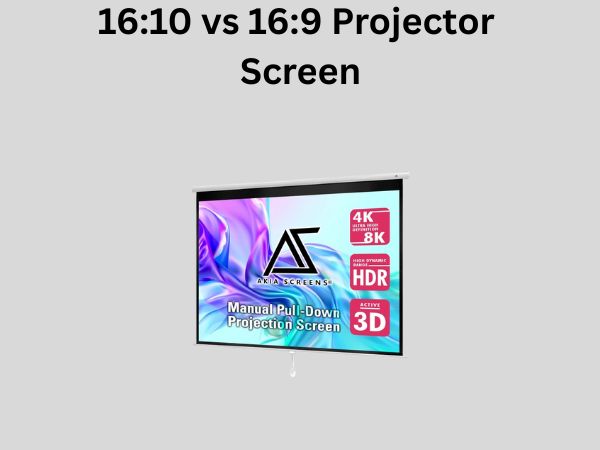
Let me start with the fundamentals, because understanding aspect ratio is crucial to this entire conversation. Aspect ratio simply refers to the relationship between a screen’s width and its height, expressed as a ratio. When we say 16:9, we mean the screen is 16 units wide for every 9 units of height. Similarly, 16:10 means 16 units wide for every 10 units of height.
Here’s what makes this interesting: that extra vertical space in a 16:10 screen might not sound significant, but in practical terms, it means you’re getting approximately 5.6% more screen real estate. Now, does that translate to a meaningfully better experience? That’s what we need to explore.
The Mathematical Difference
If you’re mathematically inclined, you’ll appreciate knowing that a 16:10 screen has an aspect ratio of 1.6:1, while a 16:9 screen measures 1.78:1. What this means in everyday language is that 16:9 screens are slightly wider relative to their height compared to 16:10 screens. A 16:10 screen is closer to what photographers and designers call the golden ratio, which some argue feels more naturally pleasing to the human eye.
The Rise of 16:9: Why It Became the Standard
You’ve probably noticed that 16:9 is absolutely everywhere. It’s on your television, your laptop, your smartphone—pretty much every consumer device uses this ratio. There’s a reason for this, and it’s not arbitrary.
The entertainment industry gravitated toward 16:9 because it struck a balance between cinema and computer displays. When streaming services like Netflix, YouTube, and Disney+ began dominating our viewing habits, they standardized on 16:9 because it was already baked into our devices. This created a self-reinforcing cycle where more content was produced in 16:9, which meant more people bought 16:9 screens, which encouraged more 16:9 content creation.
16:9 and Modern Entertainment
If you’re primarily watching movies from streaming platforms, television shows, or YouTube content, you’re almost certainly looking at 16:9 formatted material. Most projectors designed for home theater also output in 16:9. This universal adoption means that 16:9 content is optimized, readily available, and requires no letterboxing or pillarboxing—those black bars that appear when content doesn’t match your screen perfectly.
The Case for 16:10: A More Vertical Alternative
Now, let’s talk about 16:10. This aspect ratio has been hanging on in certain niches, particularly in professional and business environments. But there’s a compelling case for it in home theater too, though it’s a bit counterintuitive.
When you choose a 16:10 screen, you’re getting additional vertical real estate. This matters more than you might initially think. For instance, if you’re watching content that includes subtitles or if you occasionally watch content with unusual aspect ratios, that extra vertical space provides more flexibility. You can position subtitles lower without them disappearing off the bottom of the screen, or you can accommodate content that doesn’t perfectly fill the frame.
Professional and Business Applications
In corporate settings, presentations and documents are often created in 4:3 or 16:10 formats. If you’re someone who uses your projector for business presentations, spreadsheets, or document review, a 16:10 screen actually makes more sense. You’ll experience less wasted space and a more professional appearance when displaying typical office materials.
Screen Size Considerations: Does It Really Matter?
Here’s something interesting: the actual physical size of your screen matters as much as the aspect ratio. A 120-inch 16:10 screen and a 120-inch 16:9 screen are measured diagonally, so they’re not actually the same dimensions. Let me break this down for you.
When measured corner to corner (that’s how screen sizes are typically quoted), a 16:10 screen will actually have more height than a 16:9 screen of the same diagonal measurement. This means a 120-inch 16:10 screen will be physically taller than a 120-inch 16:9 screen. If your space has height constraints—perhaps you have limited vertical wall space—this could be a deciding factor.
Room Layout and Mounting Options
Before you decide on an aspect ratio, you need to honestly assess your room. Can you mount a taller screen? Do you have ceiling clearance? Is your viewing distance appropriate for the screen size? These practical considerations sometimes matter more than the theoretical advantages of one ratio over another.
- Measure your available wall space in both width and height
- Consider your typical viewing distance and seating arrangements
- Think about future renovations or furniture changes
- Factor in mounting hardware and installation requirements
Content Availability: What Are You Actually Watching?
This is perhaps the most important question to ask yourself. The best projector screen is worthless if you’re constantly watching content that doesn’t fill it properly. Let’s talk about what different types of content actually are.
Streaming Services and Modern Content
The vast majority of Netflix, Amazon Prime Video, Disney+, and YouTube content is produced in 16:9. If streaming entertainment is your primary use case—and honestly, it probably is for most people—then a 16:9 screen makes perfect sense. You’ll get content that fills your entire screen without any black bars, and the image quality will be optimized.
Theatrical Movies and Cinema
Here’s where things get interesting. Theatrical movies are often filmed in aspect ratios wider than 16:9, such as 2.39:1 or 2.35:1. When you watch these films on a 16:9 screen, you’ll see black bars at the top and bottom. When you watch them on a 16:10 screen, you’ll still see black bars, but slightly less of them. In practical terms, this difference is minimal and unlikely to ruin your movie-watching experience.
Sports, Gaming, and Interactive Content
If you’re planning to use your projector for video gaming, sports events, or interactive applications, 16:9 is practically universal. Gaming consoles, sports broadcasts, and esports competitions all use 16:9 as standard. Again, this points toward 16:9 as the safe, universally compatible choice.
Installation and Space Requirements
Let me walk you through some practical considerations that often get overlooked. Installing a projector screen isn’t just about picking one and hanging it on your wall. The aspect ratio you choose affects how much wall space you need and where you can position everything.
Width vs. Height Constraints
Imagine your room is relatively narrow but has plenty of vertical space. In that scenario, a 16:10 screen might be problematic because you need less additional width but might hit ceiling constraints. Conversely, if you have a wide wall but limited vertical space, a 16:9 screen makes more practical sense.
You should physically measure your space and sketch out how different aspect ratios would look. Many manufacturers provide dimension charts, which helps tremendously. Don’t just estimate—actually get a tape measure and verify your space.
Projector Placement and Throw Distance
Your projector’s throw distance—how far it needs to be from the screen to project a certain size image—is another crucial factor. Different projectors have different throw ratios, and this doesn’t change based on aspect ratio. However, the overall room layout might be affected by your choice of screen dimensions.
Brightness and Image Quality Considerations
Does aspect ratio affect brightness? Not directly. However, there’s an interesting interaction worth understanding. If you use a projector with fixed brightness output and project onto a larger screen, the image becomes dimmer because the light is spread over a greater area.
Since a 16:10 screen has about 5.6% more area than a 16:9 screen of the same diagonal size, you might notice a very slight dimming effect when using a 16:10 screen. In practice, this is negligible for most home theater applications, but it’s worth being aware of if you’re working with a lower-lumen projector or in a bright room.
Resolution and Pixel Density
Another consideration is resolution. If you have a 4K projector, the resolution is determined by the projector itself, not the screen. However, how that resolution is distributed across your screen depends on the aspect ratio. A 4K projector running in 16:9 will have slightly different pixel density than when displaying 16:10 content. This is more theoretical than practical for most viewers, but pixel enthusiasts might notice subtle differences.
Price Differences: Is 16:10 More Expensive?
Since 16:9 is more common, you’d expect it to be cheaper, and often it is. But here’s the surprise: the price difference is usually not as dramatic as you might think. A high-quality 16:10 projector screen might cost only 10-15% more than an equivalent 16:9 model from the same manufacturer.
For budget-conscious buyers, this small premium might not be worth it. For those who believe the extra vertical space justifies the cost, it’s a reasonable investment. The real money in projector setups goes into the projector itself, not the screen, so the aspect ratio choice shouldn’t break your budget either way.
The Flexibility Factor: Future-Proofing Your Setup
When making a long-term investment in a projector screen, you should consider flexibility. A 16:9 screen is more universally compatible with current and near-future content. You’re less likely to encounter content that’s optimized for 16:10, so you’re choosing the safe option.
That said, if your needs are specific—perhaps you primarily use your projector for business presentations or document review—then a 16:10 screen could be the better long-term choice for your particular situation.
Resale Value and Upgradeability
When you eventually decide to upgrade or sell your equipment, a 16:9 screen will have broader appeal. More buyers are looking for 16:9 screens because they’re the industry standard. This isn’t a huge factor for most people, but if you like to upgrade equipment regularly, it’s worth considering.
Practical Recommendations Based on Your Needs
After everything we’ve discussed, let me give you some concrete guidance based on different scenarios.
Choose 16:9 If:
- You primarily watch streaming content like Netflix or YouTube
- Your projector is used mainly for home theater and movies
- You want maximum compatibility with current and future content
- Your space has width constraints more than height constraints
- You’re on a tight budget and want the most affordable quality option
- You enjoy gaming or sports on your projector regularly
Choose 16:10 If:
- You use your projector frequently for business presentations or document work
- Your room has abundant vertical space and width constraints
- You appreciate the extra screen real estate for subtitles and positioning flexibility
- You’re willing to pay a premium for the theoretical advantages
- You want slightly better vertical real estate for content that isn’t cinema-optimized
Making Your Final Decision
Choosing between a 16:10 and 16:9 projector screen ultimately comes down to your specific situation. There’s no universally “better” option—only the option that’s better for you.
Start by honestly assessing how you’ll use your projector. What will you watch most often? How much space do you have? What’s your budget? What matters most to you—compatibility, flexibility, or specific functionality?
Once you’ve answered these questions, the decision becomes much clearer. Visit a showroom if possible and see both aspect ratios in person. Sometimes seeing them side-by-side makes the decision obvious because you realize one fits your space or aesthetic much better than the other.
Conclusion
The debate between 16:10 and 16:9 projector screens isn’t as clear-cut as many people make it out to be. Both have legitimate advantages depending on your specific needs and circumstances. For most home theater enthusiasts, a 16:9 screen remains the safer, more universally compatible choice. The content you watch is optimized for it, the prices are competitive, and you’ll never feel like you’re fighting against your equipment.
However, if you have specific needs—whether that’s professional presentation work, unique space constraints, or a preference for extra vertical real estate—a 16:10 screen could absolutely be the better investment. The extra cost is modest, and you might find that the additional functionality justifies the premium.
Whatever you choose, remember that your projector screen is just one part of a larger home theater system. The quality of your projector, the lighting in your room, your seating arrangement, and your audio setup all matter tremendously. Don’t let aspect ratio become the tail wagging the dog. Make a sensible decision based on your needs, and enjoy your projector experience.
Frequently Asked Questions
Can I watch 16:9 content on a 16:10 screen without any issues?
Absolutely, yes. When you display 16:9 content on a 16:10 screen, you’ll see thin black bars at the top and bottom of the frame. This is called pillarboxing, and it’s completely normal and harmless. The image quality remains excellent; you’re simply not using the full vertical space of your screen. Many people don’t even notice these thin bars once they’re immersed in content.
Is there a noticeable difference in viewing experience between the two aspect ratios?
For most people watching typical streaming content and movies, the difference is barely noticeable. The 5.6% additional vertical space in a 16:10 screen provides slightly more flexibility for how content is framed and where subtitles can be positioned, but this is a subtle advantage. If you’re primarily concerned with viewing comfort and image quality, both aspect ratios will serve you excellently. The difference becomes more apparent only if you’re doing specialized work like presentations or document review.
Which aspect ratio is better for gaming on a projector?
For gaming, 16:9 is the standard choice. Almost all modern video game consoles and PC gaming outputs use 16:9 as the default. Games are optimized for this ratio, and you’ll get the intended experience without any compromise. Unless you’re specifically running older games from the 1990s or 2000s, you’ll want 16:9 for gaming applications.
Will a 16:10 screen look awkward in a home theater room?
Not at all. A well-mounted 16:10 screen looks perfectly natural in a home theater environment. The difference in proportions is subtle