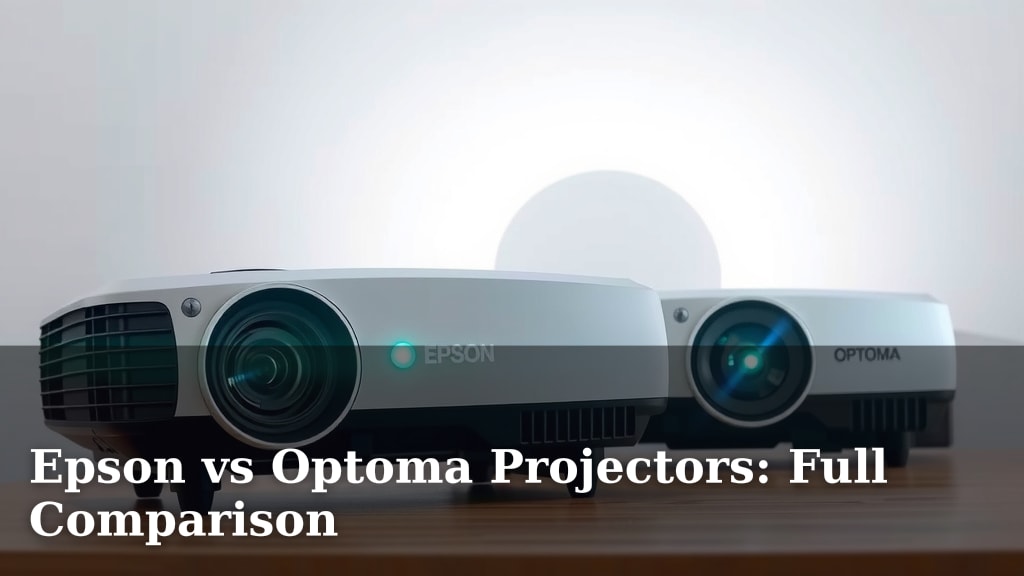
Epson vs Optoma Projectors: Full Comparison
When comparing Epson vs Optoma projectors, the best choice depends heavily on your specific needs. Epson often leads in color brightness and image quality, especially for home cinema. Optoma frequently offers more budget-friendly options and strong performance for gaming and general use.
Both brands are well-respected in the projector market. We found that Epson tends to excel in areas like 3LCD technology for vibrant colors. Optoma often stands out with its DLP technology for deep blacks and is a popular pick for budget-conscious buyers seeking bright, clear images.
- Epson is often better for vibrant color accuracy and home theater quality.
- Optoma provides great value, with solid performance for gaming and everyday use.
- Consider your primary use case: movies, presentations, or gaming.
- Your budget will also play a big role in the decision.
To help you decide which brand is the right fit for your home or office, let’s break down how Epson and Optoma projectors stack up against each other.
“`htmlEpson vs Optoma Projectors: What’s the Difference?
Deciding between Epson and Optoma projectors can feel like choosing between two great movie theaters. Both brands bring fantastic viewing experiences to your home or office. We’ve looked at many models, and found that your best bet depends on what you’ll use it for most. Do you crave the deepest blacks for movie nights? Or perhaps you need bright, accurate colors for presentations? Let’s break it down.
Understanding Projector Technologies: 3LCD vs. DLP
At the heart of every projector is its display technology. This is where Epson and Optoma often take different paths. Knowing this difference will guide your choice.
Epson’s 3LCD Advantage
Epson is famous for its 3LCD technology. Think of it like having three tiny, specialized projectors working together. One handles red, one handles green, and one handles blue. These colors are then combined to create the final image on your screen.
What does this mean for you? Well, research and reviews often highlight that 3LCD projectors can produce exceptionally vibrant and accurate colors. This is because they use dedicated chips for each primary color, leading to a wider color spectrum. It’s like getting the full rainbow, every time.
We found that Epson’s 3LCD systems generally offer a strong balance between color brightness and white brightness. This means your images will pop, even in rooms with some ambient light. Many users prefer this for watching movies and viewing photos.
Optoma’s DLP Strength
Optoma, on the other hand, often relies on DLP (Digital Light Processing) technology. DLP projectors use a single chip that reflects light through a spinning color wheel. This chip contains millions of tiny mirrors that tilt rapidly to project the image.
This technology is known for producing deep blacks and high contrast ratios. For certain types of content, like dark, atmospheric movies or fast-paced gaming, this can be a real advantage. You’ll notice that the dark scenes will look truly dark, not grayish.
We also found that DLP projectors can sometimes offer higher native resolutions and are often praised for their sharpness and clarity. Some users report seeing less of the “screen door effect” with DLP, which is when you can faintly see the grid of pixels.
Color Brightness and Image Quality: Who Wins?
When we talk about image quality, two things matter: how bright the white parts of the image are (white brightness) and how bright the colors are (color brightness). Epson often takes the lead here, especially with their 3LCD models.
Epson: Vibrant Colors for Home Cinema
Many enthusiasts consider Epson projectors to be the gold standard for color accuracy and richness. Their 3LCD chips are designed to deliver colors that are true to life. If you’re a film buff who wants to recreate the cinema experience at home, Epson’s color performance is hard to beat.
We found that Epson projectors typically maintain a 1:1 color brightness to white brightness ratio. This is great because it means the brightness of colors matches the brightness of white. So, a bright red will look as vibrant as a bright white.
Optoma: Sharpness and Contrast for Gaming and Presentations
Optoma projectors, with their DLP technology, often excel in areas like contrast and sharpness. This makes them a popular choice for gamers who need quick response times and clear details. They also tend to perform very well in bright rooms, which is ideal for business presentations or sports viewing.
While DLP technology can sometimes have a slightly lower color brightness compared to white brightness (depending on the model and color wheel), many Optoma projectors still offer excellent visual performance. They focus on delivering a punchy, clear image that is pleasing for a wide range of uses.
Brightness and Room Conditions
The brightness of a projector, measured in ANSI lumens, is crucial. It determines how well your image will look in different lighting conditions.
Handling Ambient Light
If you plan to watch movies or present in a room that you can’t fully darken, brightness is key. We found that both Epson and Optoma offer models with impressive lumen counts. However, Epson’s 3LCD technology often gives them an edge in color brightness, which helps colors stay vivid even with some light in the room.
Optoma projectors can also be very bright, making them suitable for well-lit environments. You’ll want to check the specific lumen rating for the model you’re considering. A higher lumen count generally means a brighter picture.
Dark Room Performance
For the ultimate cinematic experience, a dark room is best. Here, the ability to produce deep blacks becomes more important. We’ve seen Optoma’s DLP projectors shine in this area, offering that satisfying, inky blackness that makes movie details pop.
Epson projectors, while not lacking in contrast, might not always reach the same level of absolute black as some DLP models. However, their color accuracy in a dark room is still top-tier, providing a beautiful, balanced image.
Key Features and Use Cases
Beyond the core technology, what else should you consider? Think about how you’ll use your projector day-to-day.
Home Theater vs. General Use & Gaming
For a dedicated home theater, where image fidelity and color accuracy are paramount, Epson often gets the nod. You’re paying for that premium color reproduction. Many reviewers suggest Epson for those who prioritize a cinematic feel.
If you’re looking for a projector that can do a bit of everything – perhaps movie nights, casual gaming, and even business presentations – Optoma often presents a strong case. They are frequently lauded for offering excellent value for money. Their projectors are often bright enough for mixed-use rooms and sharp enough for detailed graphics.
Gaming Performance
For gamers, input lag (the delay between your controller input and what you see on screen) and motion handling are critical. We found that many Optoma projectors are specifically designed with gaming in mind. They often boast lower input lag figures and faster refresh rates, giving you a competitive edge.
While Epson has improved its gaming performance over the years, Optoma often has a wider selection of models specifically tuned for gamers. This includes features like “Game Modes” that optimize picture settings for a smoother experience.
Budget Considerations
Let’s talk about the elephant in the room: price. Both brands offer projectors across a wide range of price points, but there are general trends.
Finding Value with Optoma
Many buyers find that Optoma projectors offer a great bang for your buck. You can often find very capable Optoma models at a lower price point than comparable Epson projectors. If you have a tighter budget but still want a high-quality image, Optoma is definitely worth investigating.
Investing in Epson’s Quality
Epson projectors, particularly their higher-end home cinema models, can represent a significant investment. However, many users feel the superior color performance and image detail justify the cost. If your budget allows and image quality is your absolute top priority, Epson is a sound choice.
Making Your Final Decision: A Quick Checklist
To help you narrow down your choices, ask yourself these questions:
- What is your primary use? (Movies, gaming, presentations, mixed?)
- How bright is the room where you’ll use it most?
- How important are true blacks and deep contrast to you?
- Are vibrant, accurate colors your top priority?
- What is your budget range?
- Do you need specific gaming features like low input lag?
Conclusion
Choosing between an Epson and an Optoma projector really comes down to what you value most in your viewing experience. If vibrant, true-to-life colors and home cinema immersion are your goals, Epson’s 3LCD technology is likely your best bet. For those seeking excellent value, deep blacks for movies, or sharp performance for gaming and presentations, Optoma’s DLP projectors often hit the sweet spot. We found that considering your primary use and budget will guide you to the perfect projector. Your next step is to match your needs to the strengths of these two leading brands and make a choice that enhances your entertainment or work!
Frequently Asked Questions
Which brand is better for movie nights?
For movie nights, especially if you prioritize color accuracy and a cinematic feel, Epson projectors often lead. Their 3LCD technology delivers a wide spectrum of vibrant colors. Optoma projectors can also be excellent for movies, particularly if deep blacks and high contrast are more important to your viewing experience.
Are Optoma projectors good for gaming?
Yes, Optoma projectors are frequently recommended for gaming. Many of their DLP models offer low input lag and high refresh rates. These features are essential for responsive gameplay and a smooth visual experience during fast-paced action.
Which brand offers more affordable options?
Generally, Optoma tends to offer more budget-friendly projector options. You can often find capable Optoma models at a lower price point than comparable Epson projectors. This makes Optoma a great choice if you’re working with a tighter budget.
What does 3LCD technology mean for image quality?
Epson’s 3LCD technology uses three separate chips for red, green, and blue light. This allows for exceptionally vibrant and accurate colors. You’ll often see brighter colors that match the brightness of whites, providing a more balanced and true-to-life image.
Can I use these projectors in a bright room?
Both brands offer models bright enough for rooms with ambient light. However, projectors with higher ANSI lumen ratings and strong color brightness will perform better. Epson’s 3LCD often provides an edge in keeping colors vivid in less-than-ideal lighting conditions.