Mind-Blowing Visuals: How 3D Hologram Projectors Work
Have you ever watched a sci-fi movie where a character projects a glowing three-dimensional image into thin air? Well, that futuristic technology isn’t just Hollywood magic anymore. 3D hologram projectors have transitioned from the realm of imagination into our everyday reality, and they’re transforming how we experience visual content. Whether you’re curious about the technology behind these mesmerizing displays or you’re considering investing in one, I’m here to break down exactly how these incredible devices actually work.
Understanding the Basics of Hologram Technology
Before we dive into the technical nitty-gritty, let’s establish what we’re actually talking about. A hologram is essentially a photographic recording of a light field that can be viewed from different angles to reveal a fully three-dimensional image. Think of it as a photograph that has acquired an extra dimension—depth. Unlike traditional 2D images that look the same from every angle, holograms create the illusion that you’re looking at a real object floating in space.
The magic happens because holograms capture not just the intensity of light, but also its phase information. This is what separates them from conventional images and what makes them so extraordinarily realistic. When you look at a hologram, your brain receives visual cues about depth and dimensionality that are remarkably similar to what it would perceive if you were gazing at an actual three-dimensional object.
What Makes Holograms Different From Regular 3D Images
You might be wondering what separates a hologram from the 3D movies you watch with special glasses at the cinema. The key difference lies in how the images are created and perceived. When you watch a 3D film, you’re seeing two slightly different images—one for each eye—which your brain combines to create the illusion of depth. A hologram works differently. It captures the actual light field that bounces off an object, allowing you to see it from multiple angles without any special equipment, just like you would with a real object.
The History Behind 3D Holographic Displays
The journey of holography began in 1947 when Dennis Gabor, a Hungarian physicist, invented the hologram. He won the Nobel Prize in Physics in 1971 for this groundbreaking invention. However, the early holograms had a significant limitation—they required coherent light sources, and coherent light wasn’t readily available at the time. It wasn’t until lasers were invented in 1960 that holography really took off and became practical.
Throughout the decades, scientists and engineers have refined holographic technology, transforming it from laboratory curiosities into functional devices. The real revolution came with digital holography and computer-generated holograms, which eliminated the need for physical photographic plates and allowed for dynamic, changing images.
Light and Laser: The Foundation of Holograms
Why Laser Light Is Essential
Here’s where things get interesting. Ordinary light from a bulb or the sun is incoherent—meaning the light waves are jumbled together with random phases. Laser light, on the other hand, is coherent. All the light waves are in sync, traveling in the same direction with aligned wave crests and troughs. This coherence is absolutely crucial for creating holograms because it allows the light to produce interference patterns.
Imagine ripples on a pond. When two sets of ripples meet, they interact with each other, creating complex patterns where some waves amplify and others cancel out. The same principle applies to laser light. When coherent light reflects off an object and meets with a reference beam, the interaction creates interference patterns that encode all the three-dimensional information about that object.
The Role of Wavelength in Holography
Different wavelengths of light create different effects in holography. Most modern hologram projectors use red, green, or blue lasers, as these wavelengths are particularly suitable for creating vivid, detailed holograms. The choice of wavelength affects both the resolution and the color of the final hologram. Shorter wavelengths generally allow for higher resolution, while the color we perceive depends on which laser wavelengths are being used.
How Coherent Light Creates Depth Perception
Now let’s explore how coherent light actually tricks your brain into seeing depth. When a laser beam reflects off an object, it carries information about the object’s surface in the form of variations in light intensity and phase. This reflected light is combined with a reference beam—another coherent laser beam that hasn’t interacted with the object. The two beams meet and interfere with each other.
The resulting interference pattern is incredibly detailed. It contains information not just about how bright the object is, but also about how far away each part of the object is from the reference beam. This phase information is what gives the hologram its three-dimensional quality. When you view the hologram later, light passing through this interference pattern is diffracted in specific ways that recreate the original light field, allowing your eye and brain to perceive depth and dimension.
The Role of Interference Patterns in Holography
Think of interference patterns as the hologram’s secret language. They’re essentially a detailed recipe that tells light exactly how to behave when it passes through the holographic medium. The patterns consist of microscopic ridges and grooves, alternating light and dark areas at scales so small that they’re only millionths of a meter apart.
These patterns encode the complete three-dimensional information about the original object. When new light hits these patterns, it gets diffracted—bent and scattered—in precisely the right ways to reconstruct the original light field. This reconstruction is what you see when you look at a hologram. The beauty of this system is that the same interference pattern can reconstruct the image from different angles, which is why you can move your head and see different perspectives of the hologram, just as you would with a real object.
Modern 3D Hologram Projector Components
The Laser Source
At the heart of any 3D hologram projector is the laser source. Contemporary projectors typically use semiconductor lasers or solid-state lasers that produce highly coherent light in the red, green, and blue spectrums. These lasers must be incredibly stable and reliable because any fluctuations in the light output directly affect the quality of the hologram.
Spatial Light Modulators
One of the most important components in a modern hologram projector is the spatial light modulator, or SLM. This device is essentially a programmable mirror that can change its reflectivity or transmissivity at extremely high speeds. By controlling which parts of the laser beam are reflected or transmitted, the SLM can create different interference patterns, allowing the projector to display different holographic images without needing to physically change anything.
Optical Elements and Lenses
The system also requires carefully designed optical elements to shape and direct the laser beams. Lenses focus the light, beam splitters divide laser beams into reference and object beams, and mirrors direct light to where it needs to go. The precision required here is extraordinary—misalignments of even a few micrometers can significantly degrade the hologram quality.
The Projection Surface or Medium
In some hologram projectors, the interference patterns are recorded on photographic film or other materials. In digital hologram projectors, the patterns are created dynamically using the spatial light modulator. Some projectors project directly into air using a mist or fog as a medium, while others project onto screens or specialized surfaces.
The Projection Process Explained
Let me walk you through exactly what happens when a hologram projector displays an image, step by step.
- The laser source activates and produces coherent light beams
- The light is split into two paths: the reference beam and the object beam
- The object beam is modulated by the spatial light modulator based on the image data
- The reference beam remains relatively unmodified
- The two beams meet in the projection space and interfere with each other
- This interference creates the three-dimensional image that appears in space
- Your eyes perceive the diffracted light as a three-dimensional object
The entire process happens nearly instantaneously. Modern digital hologram projectors can update the image many times per second, creating the illusion of motion and allowing for dynamic, changing holograms rather than static images.
Different Types of Hologram Projector Technologies
Transmission Holograms
Transmission holograms are viewed by shining light through them, similar to how you’d look through a window. They typically display bright, colorful images and offer good image quality. Many museum exhibits and jewelry displays use transmission holograms.
Reflection Holograms
Reflection holograms are viewed by light bouncing off them, like a mirror. These holograms can be viewed in normal room lighting and often appear remarkably realistic. They’re more commonly seen in commercial applications and are the type that appears on credit cards and security documents.
Digital Hologram Projectors
Digital hologram projectors create holograms without using physical recording media. Instead, they generate the interference patterns electronically using spatial light modulators. This allows for dynamic, changeable images and is the technology most commonly used in modern commercial displays.
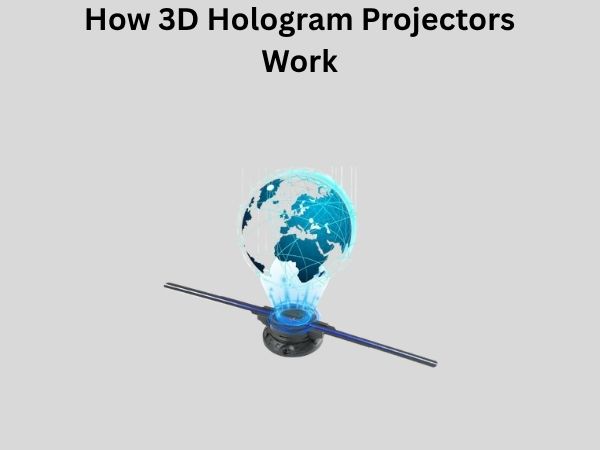
Holographic Pyramid Displays
These use a different approach entirely. Rather than relying on interference patterns, they project images onto a transparent pyramid-shaped structure. The images are reflected off the pyramid’s surfaces, creating the illusion of a hologram floating above the display. While not true holograms in the physics sense, they’re popular because they don’t require special viewing glasses and work in normal room lighting.
Advantages of 3D Hologram Projectors
So why would anyone want a hologram projector? The benefits are quite compelling.
First, they offer a completely glasses-free viewing experience. Unlike 3D cinema, you don’t need to wear special equipment to see the three-dimensional effect. Anyone can walk up and view the hologram from any angle. This makes them ideal for public displays, retail environments, and presentations where you want to engage audiences without barriers.
Second, the visual impact is extraordinary. There’s something inherently captivating about seeing a three-dimensional image floating in space. It captures attention and creates memorable experiences that traditional displays simply can’t match.
Third, they’re incredibly versatile. Once the technology is set up, you can display any image you want without changing any physical components. Digital hologram projectors can switch between images in milliseconds, making them suitable for animations, videos, and interactive displays.
Finally, they offer superior visual quality when compared to other 3D technologies. The image clarity and depth perception are remarkably realistic, approaching the realism of viewing an actual three-dimensional object.
Real-World Applications and Uses
Medical and Scientific Visualization
Surgeons are now using holographic displays to visualize complex anatomical structures before surgery. Imagine being able to rotate and examine a patient’s tumor from every angle in three dimensions before you even make the first incision. This technology is revolutionizing surgical planning and training.
Retail and Advertising
High-end retailers are using hologram displays to showcase products in ways that capture customer attention. A holographic watch or piece of jewelry can be rotated and examined just like a physical product, creating an engaging shopping experience.
Education
Museums and educational institutions are using holograms to bring historical artifacts and scientific concepts to life. Instead of looking at a flat diagram, students can examine a holographic model of a molecule, a historical figure, or an archaeological artifact from all angles.
Entertainment and Events
Concerts and live events sometimes feature holographic performers or special effects. While true holograms for this purpose are still relatively rare due to cost, the technology is advancing rapidly.
Design and Engineering
Architects and product designers are using holographic displays to visualize their designs in three dimensions, making it easier to spot issues and explore design options before physical prototypes are built.
Limitations You Should Know About
I’d be remiss if I didn’t mention the challenges and limitations of current hologram technology.
Size is one major limitation. Creating large-scale holograms that maintain image quality is extraordinarily challenging. Most current systems work best with relatively small displays, typically under a meter in any dimension.
Cost is another significant barrier. High-quality hologram projectors are expensive, often ranging from tens of thousands to hundreds of thousands of dollars. This limits their availability to large organizations and institutions.
Environmental sensitivity is also a concern. Many holographic systems require controlled lighting conditions. Bright ambient light can wash out the hologram or make it difficult to see. This is why most hologram displays are in darkened rooms or enclosed spaces.
Viewing angle restrictions exist in some systems. While true holograms can be viewed from any angle, some holographic projection systems have limited viewing angles or require viewers to be in specific positions to see the image properly.
Image stability can be an issue. If the system vibrates or if environmental conditions change, the hologram can shimmer or become unstable. This requires robust mounting and sometimes active stabilization systems.
Comparing Traditional Projectors to Holographic Ones
You might wonder how hologram projectors stack up against standard projectors and other 3D display technologies.
Traditional projectors display flat images on a surface. They’re bright, affordable, and work in various lighting conditions. However, they can’t create true three-dimensional depth perception without additional technology like 3D glasses.
3D projectors that require glasses use polarized light to send slightly different images to each eye. While effective, they require viewers to wear glasses continuously, which many people find uncomfortable during extended viewing.
Hologram projectors offer true glasses-free 3D viewing from any angle. The tradeoff is that they’re more expensive, require more controlled environments, and typically can’t achieve the same brightness levels as traditional projectors.
For most general applications, traditional projectors remain the practical choice. However, for applications where wow factor matters and the budget allows, hologram projectors deliver an unmatched visual experience.
Future Innovations in Hologram Technology
The future of holography is genuinely exciting. Researchers are working on several groundbreaking developments.
One major focus is creating larger holograms. Scientists are exploring new materials and techniques that might allow for billboard-sized holograms that maintain perfect image quality. Imagine a holographic display in Times Square or at a major shopping mall—it’s coming.
Another area of innovation is improving brightness. Current holograms can appear dim, especially in well-lit environments. New laser technologies and optical techniques promise to make holograms much brighter and more visible in daylight.
Researchers are also