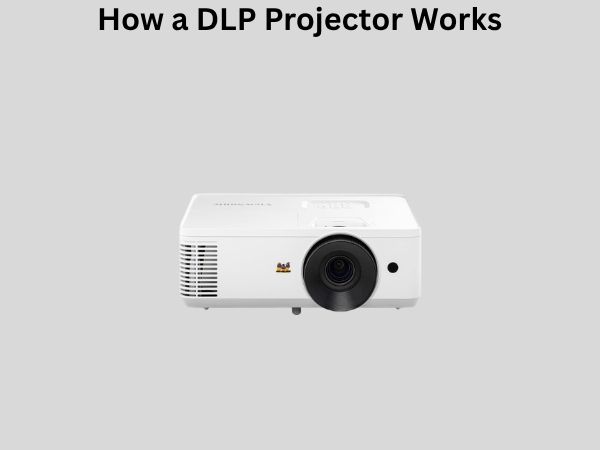
How a DLP Projector Works: The Complete Guide to Digital Light Processing Technology
Have you ever wondered what happens inside that sleek projector mounted on your office ceiling or in your home theater? What magical process transforms a tiny digital signal into a bright, crisp image projected across an entire wall? The answer lies in a fascinating technology called DLP, or Digital Light Processing. In this comprehensive guide, I’m going to walk you through exactly how these remarkable devices work, breaking down the complex technology into digestible pieces that anyone can understand.
Whether you’re considering purchasing a DLP projector, already own one, or you’re just curious about the technology, this article will give you insights into what makes these projectors tick. Let’s dive in and explore the world of digital light processing together.
What Exactly Is a DLP Projector?
Before we get into the nitty-gritty of how DLP projectors work, let me explain what DLP actually is. DLP stands for Digital Light Processing, and it’s a technology that was invented by Texas Instruments back in the mid-1990s. Think of it as the brain that controls how light gets shaped and directed to create images on your screen.
A DLP projector is fundamentally different from other projection technologies like LCD or LCoS (Liquid Crystal on Silicon). Instead of using liquid crystals or other light-filtering methods, DLP projectors rely on millions of tiny mirrors that move at incredible speeds to direct light where it needs to go. It’s like having an orchestra of microscopic mirror conductors all working in perfect harmony to paint your image onto the projection surface.
The beauty of DLP technology is that it’s incredibly reliable, produces sharp images, and can maintain brightness levels that rival much more expensive projection systems. Many movie theaters, presentation rooms, and home theaters around the world depend on DLP projectors because they deliver consistent, high-quality results.
The Core Component: The Digital Micromirror Device (DMD)
Understanding the DMD Chip
At the heart of every DLP projector lies a component so small you could barely see it with your naked eye, yet it’s doing millions of operations every single second. This is the Digital Micromirror Device, or DMD chip. Imagine a postage stamp-sized chip that contains between one and three million tiny mirrors, each one no larger than a human hair. Each of these mirrors is individually controllable and can tilt back and forth thousands of times per second.
Here’s what makes this technology so clever: each mirror represents a single pixel in your image. When that mirror tilts toward the light source, it directs light toward your screen, creating a bright spot. When it tilts away from the light source, it directs that light away from the screen, creating a dark spot. By controlling the angle and duration of each mirror’s tilt, the projector can create any shade of gray or color you can imagine.
The Precision Engineering Behind DMD
The engineering required to create a DMD chip is nothing short of extraordinary. These mirrors are constructed using CMOS (Complementary Metal-Oxide-Semiconductor) technology, the same technology that powers the microprocessors in your computer. They’re built with hinges made from metal alloys that allow millions of precise movements without wearing out or breaking down.
What’s truly impressive is the speed at which these mirrors operate. Each mirror can switch between on and off positions thousands of times per second. This rapid switching is crucial because it allows the projector to create the illusion of different colors and brightness levels, even though technically each mirror can only point light in two directions.
The Light Source: Bringing the Brightness
Different Types of Light Sources in DLP Projectors
DLP projectors don’t create their own light. They need a light source, and that source can vary depending on the projector model and its intended use. Let me explain the main types you’ll encounter.
The most traditional light source is the metal halide lamp, also called a UHP (Ultra High Performance) lamp. These lamps produce incredibly bright, white light by creating an electric arc between two electrodes. They’re powerful, affordable, and that’s why they’ve been the standard in professional projection for decades. However, they do have a limited lifespan, typically ranging from 2,000 to 5,000 hours of use.
More modern DLP projectors are increasingly using LED (Light Emitting Diode) light sources. LEDs produce light through an entirely different mechanism than lamps. They’re small, efficient, long-lasting, and produce very little heat. This means projectors using LED light sources can be more compact, quieter, and don’t require the cooling systems that lamp-based projectors need.
The newest frontier is laser light sources. Laser-based DLP projectors produce the brightest, most vibrant images possible. They’re particularly popular in large cinema installations and high-end home theaters. Lasers provide exceptional color saturation and brightness levels that lamps and LEDs simply cannot match.
Why Light Source Matters
The light source you choose affects several important factors. First, there’s brightness, measured in lumens. A brighter light source means a brighter projected image, which matters if you’re projecting in a bright room or on a large screen. Second, there’s color accuracy. Different light sources produce different color temperatures and saturation levels. Finally, there’s operating cost and maintenance. LEDs and lasers might cost more upfront but save money long-term through reduced replacement needs.
Color Creation: How DLP Produces a Rainbow
The Color Wheel Mechanism
Now here’s where things get really interesting. A single DMD chip can only produce shades of gray—variations between completely on and completely off. So how does a DLP projector create millions of colors? The answer is the color wheel, and it’s a brilliant solution to a challenging problem.
Imagine a wheel divided into colored segments—typically red, green, and blue, with possibly some white segments mixed in. This wheel rotates at very high speeds, sometimes spinning 6 times per second or faster, depending on the projector model. As the wheel spins, different colored light passes through the optical system toward the DMD chip and onto your screen.
The projector’s electronics synchronize the DMD mirror movements with the color wheel rotation. When red light passes through, the mirrors that need to create red portions of the image tilt toward the light, while others tilt away. Then, in a fraction of a second, the color wheel rotates to show green light, and the mirrors reposition themselves accordingly. This happens so quickly that your human eye perceives all the colors blending together into a complete, full-color image.
Understanding the Color Blending Process
This rapid color switching works because of a phenomenon called temporal color blending. Your eye can’t process individual color frames that flash faster than about 60 times per second, so when colors cycle through this rapidly, they appear to merge into a continuous spectrum. It’s similar to how your eye blends the red, green, and blue phosphors on a television screen into a full-color picture.
The quality of this color blending depends on several factors. Faster color wheel speeds produce smoother color transitions and can reduce rainbow artifacts—those occasional colored streaks some people see in the periphery of their vision. Higher quality DLP projectors use color wheels with more segments and faster rotation speeds to minimize these effects.
The Optical System: Directing Light to Where It Needs to Go
Lenses and Mirrors Working Together
Between your light source and the DMD chip lies an intricate optical system composed of precisely positioned lenses and mirrors. Think of this as a highway system for light. The light from your source travels through this optical pathway, getting focused and directed along the way, until it reaches the DMD chip.
The optical system includes several key components. There are focusing lenses that ensure the light from your source is concentrated and aligned. There are dichroic mirrors that might separate different wavelengths of light or combine them, depending on the projector design. Some projectors use a single-chip design with a color wheel, while others use three separate DMD chips (one for each primary color) that work in parallel.
Single-Chip vs. Three-Chip DLP Projectors
Most consumer and small business DLP projectors use a single DMD chip with a color wheel. This makes them compact and affordable. However, larger installations and cinema projectors often use three separate DMD chips, with one dedicated to red, one to green, and one to blue light. The three-chip design eliminates the need for a color wheel and provides superior color accuracy and brightness, but at a significantly higher cost.
In the three-chip design, white light from the source passes through a prism system that splits it into its three primary color components. Each colored beam then hits its own DMD chip, which manipulates it independently. The three processed beams are then recombined using another prism system and projected onto the screen. This approach delivers exceptional image quality, which is why it’s preferred for high-end applications.
From DMD to Screen: The Projection Path
The Journey of Light
After the DMD chip has done its work, manipulating millions of individual light rays, that light needs to travel from the projector to your screen. This final stage might seem simple, but it’s actually quite sophisticated.
The light leaving the DMD chip passes through a projection lens—a sophisticated optical element designed to focus the tiny image created by the DMD onto your screen while enlarging it to your desired size. The quality of this lens significantly impacts the final image quality. Better lenses produce sharper images with less distortion across the entire projected area.
The projection lens is also where throw distance comes into play. Throw distance is the distance from the projector lens to the screen. Different projectors have different throw ratios, which is the relationship between throw distance and image width. A short-throw projector might have a throw ratio of 0.4:1, meaning it can project a large image from a short distance. A standard projector might have a 1.5:1 ratio, and a long-throw projector might be 2.5:1 or greater. Understanding throw ratio helps you determine where you can physically place your projector.
Focus and Image Sharpness
For the projected image to appear sharp, the projection lens must be properly focused. Most DLP projectors include manual focus adjustment, and many higher-end models include motorized focus that can be adjusted remotely or even automatically. Some advanced projectors feature autofocus systems that constantly adjust focus to maintain image sharpness, particularly useful if the projector or screen moves.
The Electronics and Control System
Making Millions of Decisions Per Second
None of the mechanical marvel we’ve discussed would be possible without sophisticated electronics orchestrating every movement. The control electronics in a DLP projector are essentially a specialized computer dedicated to processing your video signal and converting it into instructions for the DMD mirrors.
When you send a video signal to your DLP projector—whether it’s through HDMI, DisplayPort, or another connection—the projector’s processing circuitry receives that data and must decide what each of the millions of mirrors should do. It breaks down your image into sequential frames, then for each frame, it determines the correct position for each mirror for every color cycle.
Processing and Timing
The timing involved is mind-boggling. If your projector is operating at 60 Hz refresh rate with a 6-segment color wheel spinning 6 times per second, the electronics must coordinate 36 color frames per second. With a million mirrors per frame, that’s 36 million mirror position changes every single second. Modern processors handle this through specialized hardware designed specifically for this task.
The electronics also handle image adjustment features you’re familiar with, like brightness, contrast, color adjustment, and keystone correction. These adjustments all happen in software, modifying how the projector instructs the mirrors to behave.
How DLP Compares to Other Projection Technologies
DLP vs. LCD Projectors
LCD (Liquid Crystal Display) projectors work on a completely different principle. Rather than using mirrors, they pass light through liquid crystal shutters that either allow light through or block it. While LCD projectors can be affordable and produce bright images, they typically exhibit a screen door effect—a visible grid pattern—because of the gaps between the liquid crystals. DLP projectors generally provide sharper images without this artifact.
DLP vs. LCoS Technology
LCoS (Liquid Crystal on Silicon) is another competing technology that combines aspects of LCD and DLP. It uses liquid crystals on a reflective surface similar to a mirror. LCoS projectors can produce excellent image quality, but they tend to be more expensive than DLP projectors and can be more prone to heat issues.
Why Choose DLP?
DLP projectors offer several compelling advantages. They’re typically more affordable than competing technologies while delivering excellent image quality. They’re extremely reliable because the mirror-based approach is inherently robust. They produce sharp, crisp images without visible artifacts. They work well across a wide range of brightness levels, from dim boardrooms to bright conference halls. These advantages explain why DLP technology dominates the projection market.
Key Advantages of DLP Projection Technology
- High contrast ratios producing deeper blacks and more vibrant colors
- Exceptional sharpness and image clarity
- Reliability and longevity of the DMD chip technology
- Compact projector designs possible with single-chip models
- Excellent brightness levels across the entire image
- Minimal maintenance requirements compared to LCD technology
- Wide availability and competitive pricing in the market
- Effective in both dark and bright environments
Understanding DLP Brightness and Contrast
Why DLP Produces Superior Black Levels
One reason DLP projectors are so popular is their exceptional contrast ratio—the difference between the brightest whites and darkest blacks the projector can produce. This superiority comes directly from how DLP works. When a mirror tilts away from the light source, virtually no light reaches that pixel on the screen. This creates true blacks rather than the dark grays you often see in other projection technologies.
The contrast in a DLP projector is also enhanced by something called the dark time period. Even when a mirror is tilted toward the light source, it’s not always fully illuminated. The electronics controlling the DMD can vary how long and how often each mirror remains tilted toward the light, creating subtle gradations between fully on and fully off. This gives DLP projectors remarkable ability to display subtle details in both bright and dark areas of an image.
Brightness Specifications Explained
When shopping for DLP projectors, you’ll see brightness specifications listed in lumens. The more lumens, the brighter the projector. A typical office projector might produce 3,000 to 4,000 lumens, while a large venue projector might produce 10,000 or more lumens. Higher brightness is valuable if you’re projecting in bright conditions or onto large screens. For dark room applications like home theaters, you might not need as much brightness, so a 1,500 to 2,000 lumen projector could be perfectly adequate.
Real-World Applications of DLP Technology
Cinema and Digital Projection
Movie theaters worldwide rely heavily on DLP technology. Digital cinema projectors using DLP technology deliver the crisp, vibrant images that modern filmgoers expect. Major cinema companies have standardized on DLP projectors because of their reliability, image quality, and long-term cost efficiency.
Business and Education
In corporate boardrooms, university lecture halls, and training centers, DLP projectors are the workhorse technology. They’re dependable for daily use, easy to maintain, and deliver the sharp text and clear images that presentations require. The bright, crisp images DLP produces make