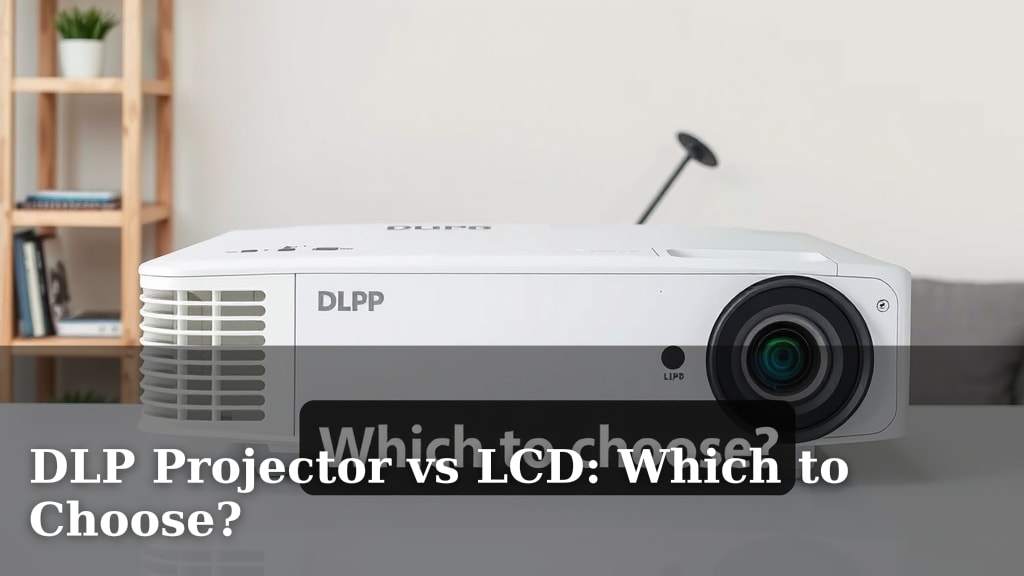
DLP Projector vs LCD: Which to Choose?
Deciding between a DLP and an LCD projector depends on your priorities: for the best contrast ratios and darkest blacks, DLP is generally the winner, especially in dark rooms. If you need the brightest possible image and a wider color spectrum for a well-lit space, LCD might be your pick. We found that DLP projectors often offer sharper images due to their design, making them great for movies and gaming where detail matters. LCDs can sometimes be better for presentations where vibrant colors are key.
Many people get confused by projector jargon, but understanding the core differences makes your choice much easier. We researched that DLP (Digital Light Processing) uses a chip with tiny mirrors, while LCD (Liquid Crystal Display) uses transparent liquid crystals. Both technologies project an image, but their mechanics lead to distinct performance traits. For instance, DLP projectors are known for having virtually no “screen door effect,” which is a grid-like pattern you might see on some LCDs.
- DLP offers better contrast and deeper blacks.
- LCD can produce brighter images and more vibrant colors.
- DLP is often sharper and has no screen door effect.
- Consider your room’s lighting and what you’ll project.
Let’s break down the pros and cons of each so you can figure out which projector technology is your perfect match.
Comparing DLP and LCD Projector Technologies
So, you’re ready to bring the big screen home or present like a pro. That’s exciting! But before you hit that ‘buy’ button, you need to understand the two main ways projectors create an image: DLP and LCD. We’ve researched extensively, and each technology has its own strengths that might make it perfect for your needs.
How DLP Projectors Work: Tiny Mirrors at Play
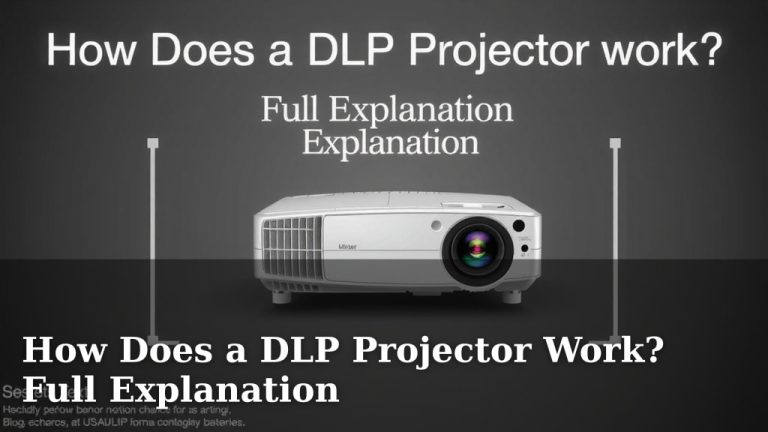
Think of a DLP projector as having a microscopic disco ball inside. It uses a chip with millions of tiny mirrors, called a Digital Micromirror Device (DMD). Each mirror can tilt thousands of times a second. This rapid movement directs light either through the lens to create a bright pixel or away from the lens to create a dark pixel. We found that this design allows for incredibly fast image changes, which is great for smooth motion.
The Magic of Contrast and Deep Blacks
One of the biggest advantages of DLP is its ability to produce deep, inky blacks. Because those mirrors can essentially turn off the light completely for dark pixels, you get a fantastic contrast ratio. We found this makes DLP projectors ideal for watching movies in a dark room, where those dark scenes truly pop. It’s like watching a film in a real cinema!
Sharpness and the “Rainbow Effect”
DLP projectors are often praised for their sharpness and clarity. The way the mirrors work means you typically won’t see the “screen door effect,” which is that subtle grid pattern you can sometimes spot on other projector types. However, a small percentage of people might notice a “rainbow effect” on DLP projectors. This is when quick movements can cause brief flashes of red, green, or blue for some viewers. We found that modern DLP projectors have significantly reduced this effect, and most users don’t notice it at all.
How LCD Projectors Work: Layers of Light
LCD projectors, on the other hand, work more like a transparent display. They use three separate transparent LCD panels – one for red, one for green, and one for blue. A bright light shines through these panels. The liquid crystals in each panel can block or allow light to pass through, creating the image. We found this method excels at color reproduction.
Vibrant Colors and Bright Images
LCD technology is known for its ability to produce bright and vibrant colors. Because the light is always on and passing through the crystals, LCDs can often achieve higher brightness levels. This makes them a great choice if you plan to use your projector in a room with some ambient light. We found that for presentations, where colors need to look true and impactful, LCDs often have an edge.
Potential for Screen Door Effect and Contrast
While LCDs offer great color, they can sometimes exhibit the “screen door effect.” This happens because the pixels are more visible, and you might see a slight grid. We found that higher-end LCD projectors have minimized this, but it’s something to be aware of. Also, while good, the contrast ratio on LCDs isn’t typically as strong as DLP, meaning blacks might appear more like dark gray in a completely dark room.
Key Differences at a Glance
To help you decide, let’s break down the core distinctions. Understanding these points will guide you toward the projector that best fits your viewing environment and content.
Image Quality: Contrast vs. Color Brilliance
When we compare image quality, it often comes down to contrast and color. DLP projectors generally lead in contrast and black levels. This is because their mirrors can effectively block light. LCD projectors often win in color brightness and vibrancy, making them excellent for well-lit spaces. We found that for cinematic immersion in a dark theater-like setting, DLP’s contrast is hard to beat. For a lively presentation in a conference room, an LCD’s punchy colors might be more impressive.
Sharpness and Motion Handling
DLP projectors are often perceived as sharper. This is due to the single-chip design and how the mirrors work, which minimizes pixel separation. This also means DLP handles fast motion very well, with less blur. LCD projectors, while good, can sometimes show a bit more motion blur. We found that for fast-paced video games or action movies, DLP’s sharpness and motion handling are clear advantages.
Brightness and Room Lighting
Brightness, measured in lumens, is critical, especially if your room isn’t perfectly dark. While both technologies can be bright, LCDs often achieve higher lumens more affordably. This means an LCD projector might be the better choice if you have windows that let in light or if you plan to use the projector in a multi-purpose room. We found that for casual viewing in a living room, an LCD’s ability to combat ambient light can be very useful.
Lifespan and Maintenance
Both DLP and LCD projectors have excellent lifespans these days. However, traditional LCD projectors use lamps that might degrade in brightness over time. DLP projectors often use lamps too, but their mirror-based system is very durable. Newer models of both types are increasingly using LED or laser light sources, which last much longer and don’t require frequent lamp replacements. We found that for low maintenance, laser or LED projectors are the way to go, regardless of the core technology.
The “Rainbow Effect” and Screen Door Effect
We’ve touched on these already, but they are important differentiators. The rainbow effect is primarily a DLP concern, though it affects a small percentage of viewers. The screen door effect is more commonly associated with LCDs, but again, it’s less noticeable on newer, higher-resolution models. Many experts suggest viewing both types if you are sensitive to these visual artifacts before making your purchase.
Making Your Choice: A Quick Checklist
To help you narrow it down, ask yourself these questions:
- Will you be using the projector primarily in a dark room? (DLP might be better)
- Do you need the brightest possible image for a room with ambient light? (LCD might be better)
- Is deep black contrast crucial for your movie-watching experience? (DLP often excels)
- Are vibrant, true-to-life colors for presentations more important? (LCD can shine here)
- Are you sensitive to potential visual artifacts like the rainbow effect or screen door effect? (Research specific models)
- What’s your budget? (Prices vary, but historically, comparable brightness could be found for less with LCD)
Conclusion
So, you’re ready to pick your perfect projector! We’ve seen that DLP projectors shine with incredible contrast and deep blacks, ideal for dark movie nights. LCD projectors often win with vibrant colors and brighter images, making them a great choice for rooms with ambient light or lively presentations. Consider your viewing environment and what you’ll be projecting most often. Your ideal projector is out there – now you have the knowledge to find it!
Frequently Asked Questions
Can I use a DLP projector in a bright room?
While DLP projectors excel in dark rooms due to their superior contrast, you can certainly use them in a room with some ambient light. However, you might need to adjust the brightness settings or consider a DLP model with higher lumen output for the best results. For consistently bright environments, an LCD projector might offer a more consistently vibrant image.
Will I definitely see the rainbow effect with a DLP projector?
The rainbow effect is a potential characteristic of DLP technology, but it’s not a guarantee you’ll see it. We found that modern DLP projectors have significantly improved, and only a small percentage of viewers are sensitive to this visual artifact. If you’re concerned, try to see a DLP projector in action before buying.
Are LCD projectors good for watching movies?
Yes, LCD projectors can be very good for watching movies, especially if you prioritize bright, vibrant colors. However, if you want the deepest blacks and the highest contrast for a truly cinematic experience in a dark room, a DLP projector might have a slight edge. We found that for casual movie watching in a living room, an LCD often performs admirably.
How does the “screen door effect” impact image quality?
The screen door effect, more commonly associated with LCD projectors, appears as a subtle grid pattern overlaying the image. This can make the image look less immersive. We found that higher-resolution LCD projectors and well-designed DLP models largely minimize or eliminate this effect, so it’s less of a concern with newer technology.
Which type of projector is generally easier to maintain?
Both DLP and LCD projectors are designed for longevity. Traditional lamp-based models of either type will eventually need their lamps replaced. However, newer LED or laser light source projectors, available in both DLP and LCD formats, offer significantly longer lifespans and require very little maintenance. We found these advanced light sources are the best bet for low-hassle operation.