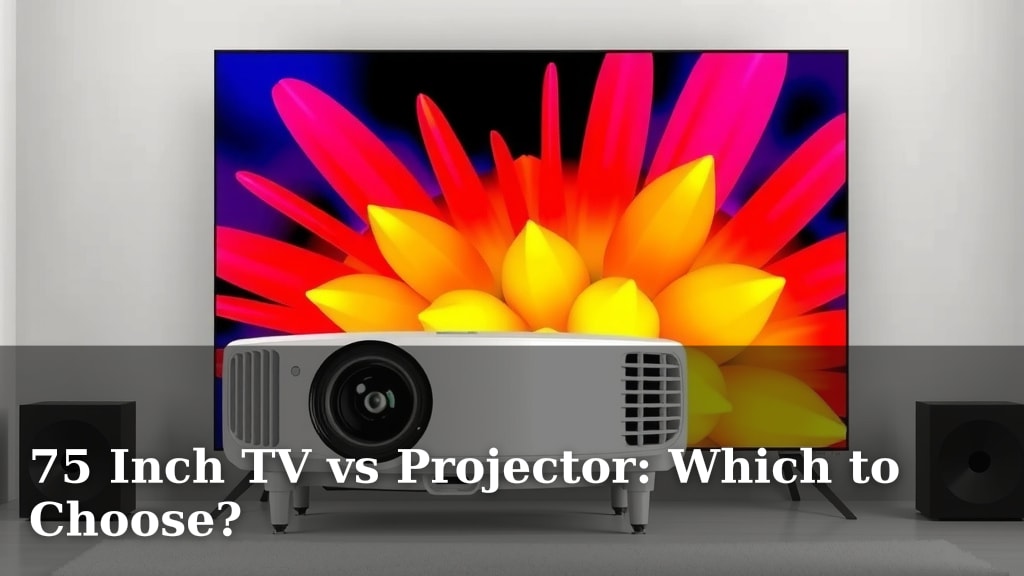
75 Inch TV vs Projector: Which to Choose?
Choosing between a 75-inch TV and a projector depends on your room and viewing habits. For bright rooms and everyday viewing, a large TV offers superior convenience and picture quality. If you crave a true cinema experience and have a dedicated dark space, a projector might be your winner.
We know deciding on home entertainment can be tough. Both options aim to give you a big-screen feel, but they do it differently. Think about your lighting conditions and how much space you have. Your perfect setup hinges on these details.
- TVs are great for bright rooms and easy setup.
- Projectors shine in dark rooms for a true cinema feel.
- Consider your room size and ambient light carefully.
- Budget also plays a big role in which is right for you.
Let’s break down the pros and cons of each so you can make the best choice for your home theater dreams.
Big Screen Showdown: 75-Inch TV vs. Projector
So, you’re dreaming of a massive screen for movie nights, gaming, or just a more immersive way to watch your favorite shows. That’s fantastic! You’ve narrowed it down to two popular contenders: a large 75-inch TV or a projector. Both promise a big visual experience, but they go about it in very different ways. Let’s figure out which one is the perfect fit for your home.
Understanding Your Viewing Environment
The biggest factor separating TVs and projectors is your room’s lighting. Think of it like this: a TV is like a bright, sunny day, while a projector is like a classic movie theater. This one difference impacts almost every other aspect of your choice.
The Bright Room Advantage: Why TVs Shine
If your living room gets a lot of natural light or you enjoy watching TV during the day, a 75-inch TV is usually the smarter pick. TVs are built to overcome ambient light. Their self-emissive pixels produce a bright, vibrant image that won’t get washed out. We found that even with moderate sunlight, a good TV picture remains clear and defined.
The Dark Room Delight: Where Projectors Excel
On the flip side, projectors need darkness to truly perform. Think of it like an artist needing a dark studio to perfectly blend colors. When you dim the lights and close the curtains, a projector can create a truly cinematic experience that’s hard to match. Many enthusiasts agree that a dark room is non-negotiable for projector quality (Home Theater Magazine).
Picture Quality: Beyond Just Size
While both options give you a large image, the way they achieve it affects the picture quality in different ways. It’s not just about how big the screen is; it’s about what you’re seeing.
TV Picture Perfection
Modern 75-inch TVs offer stunning clarity with technologies like 4K and HDR. You’ll get deep blacks, bright whites, and a wide range of colors. The sharpness and detail are incredible, making every image pop. We found that TVs generally offer a more consistent picture, no matter the content.
Projector Possibilities and Pitfalls
Projectors can also deliver amazing 4K resolution and HDR. However, their performance is heavily influenced by the screen you use and the room’s darkness. Dust on the lens or a poorly lit room can significantly reduce contrast and color vibrancy. You might also notice a “screen door effect” on some models, where you can faintly see the pixel grid.
Brightness Matters: Lumens Explained
Projector brightness is measured in lumens. For a well-lit room, you’d need a projector with 3000 lumens or more. For a dark home theater, 1500-2000 lumens might be plenty. We found that choosing the right lumen count is critical for achieving a good image based on your specific room conditions.
Installation and Space Considerations
How easy is it to set up, and what kind of space do you need? This is where the two options really diverge.
The TV’s Simplicity
Setting up a 75-inch TV is generally straightforward. You’ll place it on a stand or mount it on the wall. Then, just plug it in, connect your devices, and you’re good to go. It’s a plug-and-play experience for most users.
The Projector’s Puzzle
Projectors require a bit more thought. You need space for the projector itself, often mounted on the ceiling or placed on a shelf. You also need a suitable projection screen, which can be a fixed frame, a pull-down, or even a painted wall. Getting the correct throw distance (how far the projector needs to be from the screen) and alignment can take some effort.
Screen Size Flexibility
One major win for projectors is their flexibility. You can often create an image that’s 100 inches, 120 inches, or even larger. A 75-inch TV is, well, 75 inches. If you dream of a truly massive, wall-filling picture, a projector offers that scalability.
Audio: What You’ll Hear
Sound is half the experience, right? Here’s how TVs and projectors handle it.
TV Sound Systems
Most modern TVs have built-in speakers. While they’ve improved, they’re often adequate but not spectacular. For a truly immersive audio experience, you’ll likely want to add a soundbar or a separate surround sound system. This is an additional cost to consider with a TV.
Projector Sound Solutions
Projectors typically have very basic, often quiet, built-in speakers. You absolutely need an external sound system with a projector. This usually means connecting to a soundbar, AV receiver, or powered speakers. It’s an essential part of the projector setup.
Durability and Lifespan
How long will your investment last? This is an important question for any home entertainment system.
TV Longevity
A 75-inch TV is generally built to last for many years, often 7-10 years or more with normal use. The panels are quite durable. You can expect consistent performance throughout its lifespan.
Projector Lamp Life
Projector bulbs have a limited lifespan, typically ranging from 2,000 to 15,000 hours, depending on the model and usage. While LED and laser projectors have much longer lifespans, traditional lamps will eventually need replacing. This is an ongoing cost and a potential point of failure.
Cost Comparison: What to Expect
Budget is always a factor. Here’s a general idea of what you might spend.
| Category | 75-Inch TV (Approximate Cost) | Projector Setup (Approximate Cost) |
|---|---|---|
| Display Unit | $800 – $2,500+ | $500 – $2,000+ (for projector) |
| Screen/Mounting | $0 – $300 (for wall mount) | $100 – $500+ (for screen, mount) |
| Audio System | $0 – $500+ (optional soundbar) | $200 – $1,000+ (essential sound system) |
| Total Estimated Cost | $800 – $3,300+ | $800 – $3,500+ |
As you can see, the initial cost can be similar. However, remember that a projector often requires additional purchases like a screen and a sound system to be fully functional, which can increase the overall investment.
Your Decision Checklist
Still weighing your options? Ask yourself these quick questions:
- Do you watch TV mostly in a bright room? (TV likely wins)
- Do you have a dedicated, dark space for movie nights? (Projector shines)
- Is ease of setup a top priority? (TV is simpler)
- Do you crave the largest possible screen size? (Projector offers more)
- What’s your budget for the total system, including audio? (Both can be similar, but projectors may need more add-ons)
- How important are perfect blacks and contrast in all lighting conditions? (TV usually better)
Conclusion
So, you’re ready to pick your big screen. A 75-inch TV is your best bet for bright rooms and simple setup. It offers stunning clarity and convenience for everyday viewing. If you’re after a true cinema feel and have a dedicated dark space, a projector delivers that immersive, wall-sized experience. Your room’s lighting and your desired screen size are key. We found that considering the total system cost, including audio and any necessary accessories, is vital. Now, go create that home entertainment oasis you’ve been dreaming of!
Frequently Asked Questions
Can I use a projector in a moderately lit room?
While projectors perform best in darkness, some high-lumen models can combat moderate ambient light. We found that even with a brighter projector, the picture will still be somewhat washed out compared to a TV. For the best experience, dimming the lights is always recommended with a projector.
How much brighter are TVs compared to projectors?
TVs are inherently much brighter than projectors. A typical 75-inch TV can easily produce 500-1000 nits (a measure of brightness), while a good home theater projector might offer 100-200 nits on its screen. This difference is why TVs excel in bright environments and projectors need darkness.
Do projectors have built-in speakers, and are they good?
Most projectors have small, basic built-in speakers. We found these are usually not sufficient for an immersive viewing experience. You’ll almost always need to connect an external sound system, like a soundbar or speakers, for decent audio quality with a projector.
What’s the lifespan of a TV panel versus a projector lamp?
A TV panel typically lasts 7-10 years or more with regular use. Projector lamps, on the other hand, need replacement after 2,000 to 15,000 hours, depending on the type. Newer LED or laser projectors have much longer lifespans, often comparable to TVs, but traditional lamps are a recurring cost.
Can a projector truly replace a TV for daily use?
For everyday TV watching, especially during the day, a TV is generally more practical. Projectors are better suited for dedicated movie nights or special viewing events due to their light requirements and setup. We found that TVs offer a more convenient, all-around solution for daily entertainment needs.